
AI from potential
to practice.
Discover where AI can create real value in your business – and where it makes sense to start.
We support AI adoption and implementation in your business: from relevant tasks and concrete use cases to implementation and sustainable use.
A relevant task.
A measurable goal.
We start with your daily work and assess which AI solution fits.
Your kick-off.
A clear foundation.
You receive a transparent prioritisation and a recommendation on which use case makes sense to tackle first.
- Preparation and structured conversations with selected managers and employees
- A facilitated workshop to identify and define use cases
- Assessment of value, feasibility, data, risks and organisational prerequisites
- Prioritisation and recommendation for the first use case
- A concise decision brief with next steps
What happens after the kick-off?
If you wish, we can support you from the first pilot through implementation and introduction to employee training and sustainable adoption.
The fixed price covers the kick-off only. Piloting, technical implementation, introduction, training and ongoing support are separate services to be agreed individually.
Introduce AI. Build lasting impact.
Start with the right use case. Learn. Improve. Move on to the next one when needed.
Step by step from 01 to 08. Phases 01–04 form the kick-off; phases 05 onwards are separate services to be agreed individually.
- Kick-off
Phase 1: Discover potential
Understand daily work. Identify use cases.
Concrete use-case listWhat happens here?
Through structured conversations with employees and managers, we gather relevant tasks, bottlenecks and ideas for improvement. We describe which problem should be solved, for whom and at which point in the process.
- Kick-off
Phase 2: Set the guardrails
Review data, security and prerequisites.
Transparent conditionsWhat happens here?
We consider data availability and quality, data protection, information security, confidentiality, internal policies, regulatory requirements, the technical environment and roles. Relevant specialists and, where appropriate, employee representatives are involved.
- Kick-off
Phase 3: Assess value
Evaluate feasibility and ROI potential.
Initial business-case hypothesisWhat happens here?
We record the baseline and measurable criteria, then assess expected benefits, effort, costs, feasibility, risks and acceptance. Where possible, we develop an initial business-case or ROI hypothesis.
- Kick-off
Phase 4: Choose a starting point
Prioritise and decide together.
Prioritised decision briefWhat happens here?
We compare the options transparently. A joint project or steering group decides which use case to pursue first. The decision and any outstanding prerequisites are documented.
- Separate follow-on phase
Phase 5: Run a pilot
Plan the solution and test it on a small scale.
Pilot ready for evaluationWhat happens here?
We define the target process, scope, responsibilities, solution approach, data and access, human oversight, tests, security measures and success criteria. The pilot is implemented with the responsible internal and, where appropriate, external specialists.
- Separate follow-on phase
Phase 6: Review the impact
Compare results with the baseline and goals.
Evidence-based next decisionWhat happens here?
Using the agreed criteria, we review factors such as time, quality, costs, errors, user acceptance and risks. Together, we decide whether to adapt, expand or stop the pilot.
- Separate follow-on phase
Phase 7: Enable your people
Introduce, train and embed in daily work.
An enabled teamWhat happens here?
Workflows and responsibilities for regular operations are defined. Role-specific training covers application, AI limitations, checking results, data protection and escalation routes. Communication, support and, where needed, internal champions accompany the introduction.
- Separate follow-on phase
Phase 8: Sustain adoption
Secure the benefits and keep improving.
Continuous improvementWhat happens here?
Usage, quality, impact, risks and feedback are reviewed regularly. Responsibilities and support are established, improvements implemented and further suitable use cases prioritised when benefits have been demonstrated.
Feed back lessons learned and extend the evaluation where needed.
If the pilot is stopped
Document the results and reasons, capture lessons learned and decide whether to pursue a different use case.
Guardrails are clarified before piloting and considered throughout implementation and use. The diagram shows a sequence, not a fixed project duration.
Download the process overview as an SVG (German)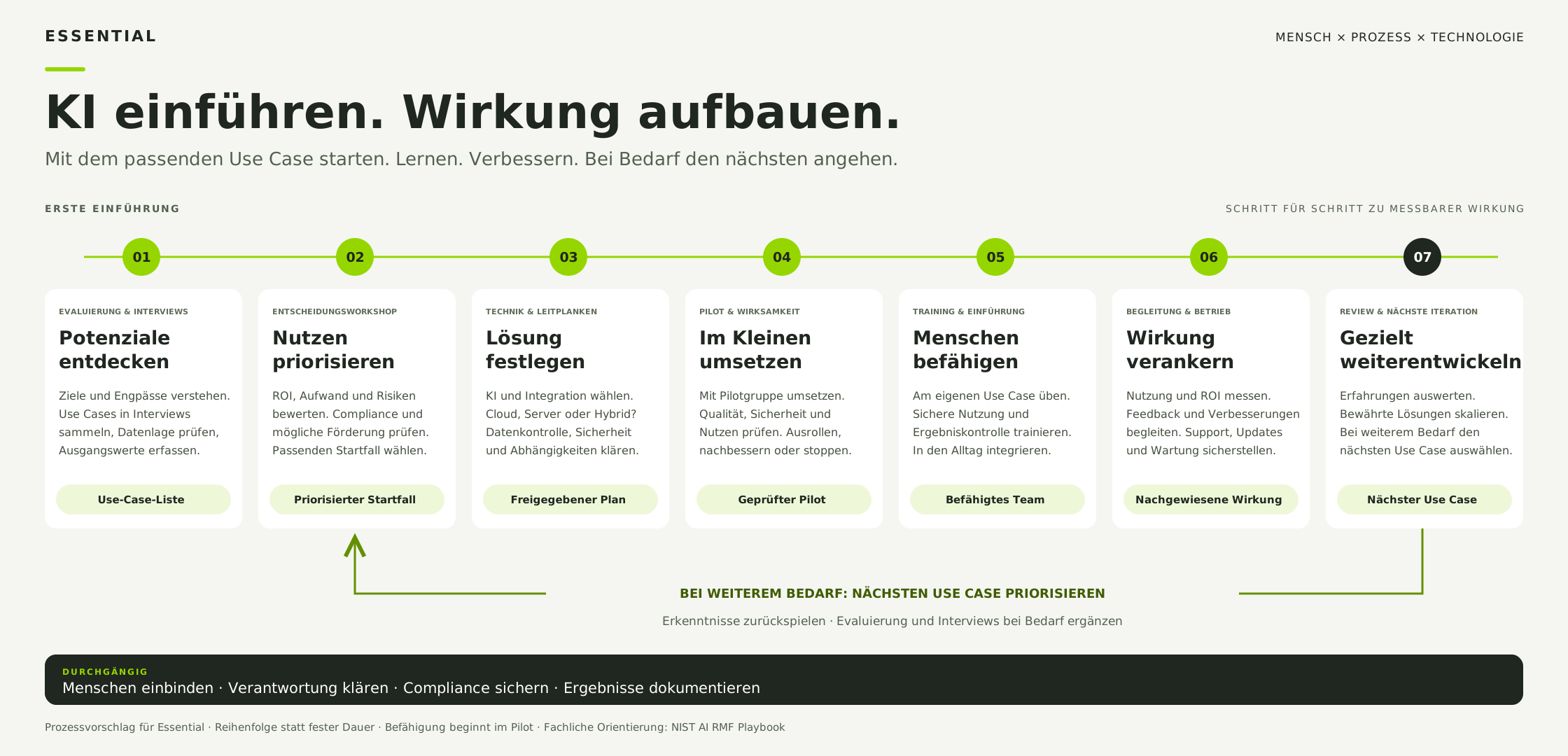
From initial assessment
to a practical starting point.
The AI Business & Risk Check structures opportunities, the business case and relevant risks. The AI Use-Case Kick-off complements this service: it focuses on concrete tasks, involves the people affected and leads to prioritisation and the next decision.
The risk and compliance assessment is a structured preliminary review and basis for decision-making. It is not legal advice or formal certification. Relevant specialists are involved where needed.
Where could AI improve your daily work?
Let us find the right starting point together.
Arrange an initial consultation